Mobile Diagnostics for Truck Emissions Problems Explained
Quick Summary
Mobile diagnostics for truck emissions problems let a technician read fault codes, check live sensor data and run tests where the truck is parked, often saving a day of towing. The visit cannot always confirm a failed part on the spot, since one code can be triggered by a sensor, wiring or a real restriction.
A mobile visit can read stored and active codes and check live NOx and exhaust temperature sensor data.
Many roadside checks take less than an hour once the truck is connected to a scan tool.
A fault code identifies a detected condition, not a confirmed failed part.
Check DEF level and quality before replacing sensors, since low or contaminated fluid can mimic sensor faults.
Clear codes only after recording freeze-frame data, because clearing erases the conditions that explain the fault.
Is your truck's emissions light on?
24/7 Big Rig Repair and Road Service provides mobile diesel diagnostics and roadside repair in Portland.
Table of Contents
What Mobile Diagnostics Can and Cannot Find in Truck Emissions Systems
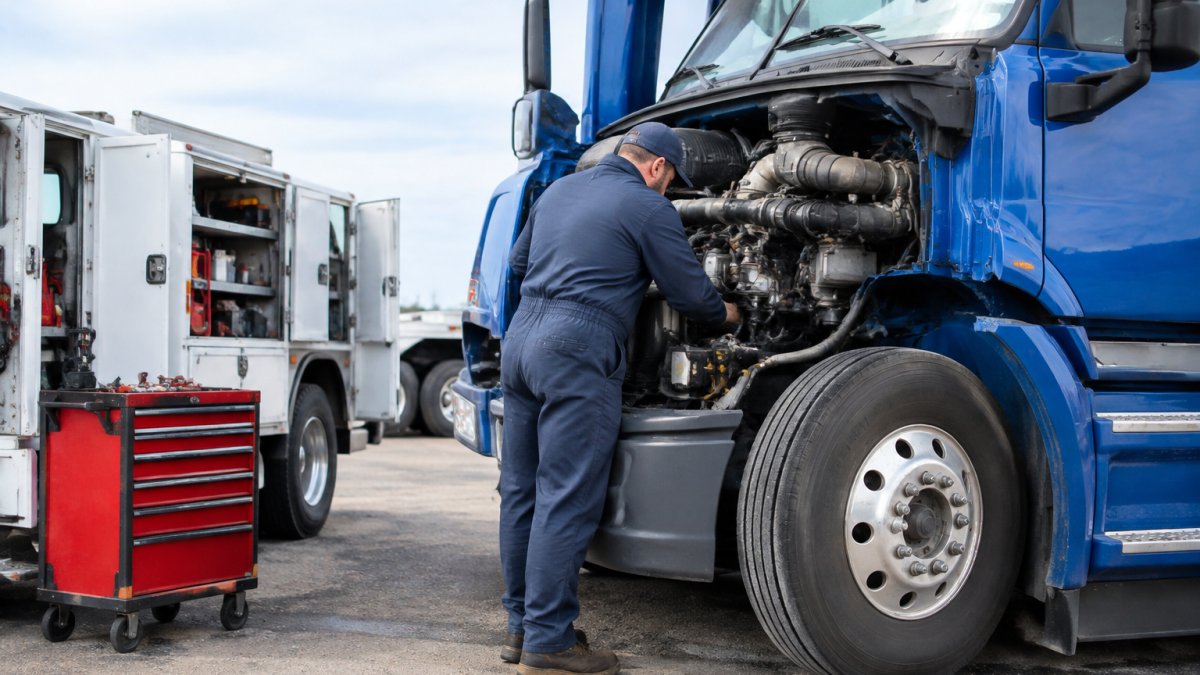
Mobile diagnostics for truck emissions problems let a technician read fault codes, check live sensor data and run tests right where the truck is parked. That can save a day of towing. It also has limits, and knowing them up front keeps you from paying for a visit that cannot solve the problem.
A mobile visit works well for reading stored and active codes, checking live data from the NOx and exhaust temperature sensors, and confirming whether the aftertreatment system is regenerating. It can also show whether a regeneration request is stuck or a derate is active. Many of these checks take less than an hour once the truck is connected.
What it cannot always do is confirm a failed part on the spot. A code tells you where the system saw a problem, not always which component caused it. A clogged DPF, a bad sensor and a wiring fault can all trigger the same code. Some repairs also need a shop lift, bench testing or a dealer-level software update.
Watch out: Replacing a part based only on a code often costs more than the diagnostic itself. Ask the technician to explain what the live data shows before you approve a repair.
Diesel Engine Diagnostic Tools Used in a Roadside Emissions Check
A roadside emissions check starts with a scan tool plugged into the diagnostic port. The tool pulls fault codes from the engine control module and the aftertreatment control module. It also streams live data, which shows what each sensor is reporting right now.

Common tools in the field include:
Heavy-duty scan tools that read both engine and aftertreatment modules
Multimeters and oscilloscopes for checking sensor circuits and wiring
Pressure gauges for measuring differential pressure across the DPF
Thermal probes for checking exhaust temperatures at key points
The California Air Resources Board's heavy-duty emissions research uses on-board diagnostic data from over 200 trucks, along with 60 chassis-dynamometer tests, to study real-world behavior (CARB Mobile Source Emissions Research on heavy-duty vehicles). That kind of data is why live readings matter more than a single code.
Reading the Truck Emissions Warning Light and Common Fault Codes
The emissions warning light, often a yellow engine icon or a separate DEF light, signals that the aftertreatment or emissions control system has detected a condition outside its normal range. The light alone does not tell you the severity, the cause, or whether the truck will lose power. Read the dash message, note whether the light is steady or flashing, and check whether the truck has entered a derate or inducement state before deciding how urgent the situation is.
Fault codes follow a standardized structure. The first part typically identifies the system involved, such as NOx, DPF, DEF, or exhaust temperature. The remaining digits or letters describe the fault type, such as out of range, signal erratic, or circuit open. Learning this structure lets you read an unfamiliar code and at least know which subsystem to investigate.
A code identifies a condition the control module detected, not a confirmed failed part. This distinction matters because the same code can be triggered by a failed sensor, a damaged harness, a bad connector, a module fault, or a real problem the sensor is accurately reporting, such as an overly restricted filter. Treating the code as a verdict on one component is the most common route to unnecessary repairs.
Several commonly seen codes show how this plays out in practice. A low DEF level code is usually straightforward, but a DEF quality code can point to contaminated fluid rather than an empty tank, and that calls for a different response. A DPF restriction code may reflect a genuinely loaded filter, or it may reflect a differential pressure sensor or its hoses giving false readings. A NOx sensor signal code could be the sensor, its wiring, or an SCR condition that drives the reading.
To avoid overdiagnosing, record the exact code, the mileage, the freeze-frame conditions, whether the light is steady or flashing, and whether it appears with a power loss. Then ask whether the readings support the code. If the sensor value looks plausible and the circuit tests good, the problem may be upstream of the component the code names.
Watch out: Ordering a part as soon as a code appears often replaces a good component and leaves the real fault in place, so confirm the cause with live data first.
Step-by-Step Emissions Troubleshooting Workflow
A consistent order keeps you from replacing parts that were never at fault. Each step below narrows the cause before the next one begins, and most of the time you can stop early once the data points to a specific circuit or condition.
Read all codes and freeze-frame data. Record every active and stored code, along with its status and the conditions present when it was set, such as engine speed, load, exhaust temperature, and vehicle speed. Freeze-frame data tells you whether a fault happened at idle, under load, or during a regeneration, which often narrows the cause more than the code name does.
Check the basics before the sensors. Confirm the DEF level, look at the fluid for contamination or crystallization, and inspect hoses, clamps, and the DEF pump connector for leaks or damage. A low or contaminated DEF supply can trigger SCR faults that look like sensor failures, so ruling it out first saves time.
Review live data under controlled conditions. Watch NOx sensor readings, exhaust temperatures before and after the DPF, differential pressure across the filter, and DEF dosing commands. Compare values at idle and under a steady load. Look for readings that are flat, slow to respond, or that disagree with each other, because a sensor that reports a believable but wrong value is harder to catch than one that reports nothing.
Test the suspect circuit, not just the part. Verify reference voltage, ground integrity, and signal wiring with a multimeter, and check connectors for corrosion or pin push-out. Many emissions codes are triggered by wiring faults that look identical to component failures in the scan tool output. Testing the circuit tells you whether the sensor, the harness, or the module is responsible.
Attempt a regeneration only when it is safe. If the system allows a parked or forced regeneration, run it with the truck stationary, in a safe location, and with the manufacturer's conditions met. Record whether the regeneration completes, stalls, or is interrupted. A regeneration that will not start often points to a temperature, pressure, or inhibit condition rather than a failed filter.
Clear the code and retest. After any repair or adjustment, clear the stored codes and run the truck through the conditions that originally set them. If the fault returns with the same freeze-frame pattern, the root cause is still present. If it returns with a different pattern, you may have found a second, unrelated fault.
Decide on the repair from the data. Approve a repair only when the readings and circuit tests support a specific failure. If the evidence is inconclusive after steps one through six, that is a signal to escalate to a shop with bench-test capability or a dealer-level software resource rather than to replace parts on a guess.
Watch out: Clearing codes before recording freeze-frame data erases the conditions that explain when the fault happened, so always capture the full data set first.
Step | Typical Check | What It Tells You | When to Stop or Escalate |
1 | Fault codes and freeze frame | Which system reported a fault and under what conditions | Never stop here; always complete the set |
2 | DEF level, quality, and leaks | Whether basic supply issues explain the fault | If supply is clearly faulty, repair it and retest |
3 | Live sensor data | How the system behaves now | If readings are plausible and consistent, move on |
4 | Circuit testing | Wiring, power, or component fault | If the circuit tests good, suspect the module or escalate |
5 | Regeneration test | Whether the DPF can clear itself | If regeneration is inhibited by a condition, address that condition |
Truck Aftertreatment Diagnostics: DPF, DEF and SCR Faults
The aftertreatment system cleans exhaust using a diesel particulate filter (DPF), diesel exhaust fluid (DEF) and a selective catalytic reduction (SCR) unit. Each part can fail on its own, and a fault in one often shows up as a fault in another.
A DPF that is restricted causes a pressure rise that the system detects (Technical Bulletin: Diesel Particulate Filter General Information). Regeneration burns off the soot, but short trips or low-speed driving can keep the filter from cleaning itself. DEF problems include low fluid, contaminated fluid and a faulty injector. SCR faults often trace back to the NOx sensors or to DEF quality.
Watch out: Pouring in a different fluid or running the truck with a faulty SCR system can cause costly damage. Stick with certified DEF and fix the root cause.
How Remote Fleet Diagnostics Support Mobile Emissions Repairs
Fleet telematics can send fault data to the repair team before the truck stops. That lets a technician plan the visit, bring the right parts and tools, and often start with a likely cause.
Booking Your Roadside Emissions Diagnostic Visit
When you call for a visit, have the truck's make, model and year ready, along with the fault codes and the mileage. You can contact the team for emergency roadside assistance directly. Describe what the dash is showing and whether the truck has lost power. This lets the team decide what to bring.
Call 24/7 Big Rig Repair and Road Service to describe the problem and arrange a visit. You can also review mobile truck repair and diagnostic services to see what is covered on the road. The team can tell you what a roadside check can cover and what may need a shop.
Last Updated: November 11, 2026
Frequently Asked Questions
How much does a diagnostic cost on a truck?
Diagnostic pricing depends on the truck, the fault, and the time required on site. 24/7 Big Rig Repair and Road Service publishes its pricing on its website, and a quote can be requested before a technician is dispatched. Ask whether the diagnostic fee is applied toward a repair if one is performed, and confirm what is charged if the problem cannot be fixed roadside and the truck must be towed. Comparing a written quote with the scope of work helps avoid surprise charges.
Can a mobile mechanic diagnose problems with truck emissions systems?
A mobile technician can read diagnostic trouble codes, check live sensor data such as exhaust temperature and differential pressure, and test components like the NOx sensor and DEF dosing system on site. Many emissions faults can be narrowed down roadside. Some causes, such as internal DPF damage or certain wiring faults, may require a shop with additional equipment. A good mobile diagnostic visit should state clearly what was confirmed and what still needs workshop testing.
What should I do when a diesel truck shows an emissions warning light?
Note whether the light is steady or flashing, and whether the truck has lost power or entered derate mode. Record any fault codes shown on the dash display. If the truck is still safe to drive and the light is steady, schedule a diagnostic soon rather than ignoring it, since a developing DPF or SCR fault can progress into a no-start or limp condition. If power is lost or the truck is unsafe, stop and call for roadside service.
How long does mobile diesel diagnostics usually take?
The time depends on how many systems are involved and whether the fault is intermittent. Reading codes and checking live data for a single emissions fault often takes under an hour on site. Intermittent problems, or faults that need component testing or a forced regeneration, can take longer. The technician should explain the expected timeline when the visit is booked and give an update if the diagnosis extends beyond the initial estimate.
Comments